Allen Bradley PLCs on eBay: CompactLogix, ControlLogix & Legacy Buyers Guide
uBuyFirst
Allen Bradley PLCs hold their value on the secondary market better than almost any other industrial automation hardware. A 1769-L33ER CompactLogix that lists for over $3,000 from an authorized Rockwell distributor regularly sells as surplus on eBay for $1,100 to $1,800. A 1756-L72 ControlLogix that carries a $4,500+ list price moves between $1,000 and $2,200 in surplus channels. Those savings matter when you are spec'ing a panel or stocking a spare parts shelf.
I have been buying AB processors on eBay for integration projects and resale for years. The deals are real, but so are the risks. Counterfeit units from overseas sellers, locked processors with previous owners' programs still on them, firmware mismatches that only surface after you try to go online with Studio 5000 -- these are all problems I have dealt with firsthand. This guide covers what I have learned about navigating the eBay market for Allen Bradley PLCs, from catalog number basics through testing a used processor on your bench.
For a broader look at buying all Allen Bradley product lines on eBay, see the complete Allen Bradley buying guide.
PLC Families: Which Platform Fits Your Application
Allen Bradley's PLC lineup spans five decades of product development. What shows up on eBay reflects that range. Here is a breakdown of each platform and when it makes sense to buy one used.
CompactLogix is where most of the eBay action happens. The 5370 series (1769-L3x catalog numbers) remains the workhorse for small-to-mid-size machines and processes. These controllers support 1 to 5 MB of user memory, dual EtherNet/IP ports, and up to 16 local I/O modules across three expansion banks. The newer 5380 series (5069-L3xx catalog numbers) pushes performance further with up to 10 MB of memory, support for up to 180 EtherNet/IP nodes, and gigabit communication speeds. If you are building new or expanding, a 5069-L320ER at $1,700 to $2,700 surplus is a strong buy. If you are replacing a failed processor in an existing 1769 chassis, a 5370 like the 1769-L33ER at $1,100 to $1,800 keeps you compatible without rewiring anything.
ControlLogix is the big platform. The 5570 series (1756-L7x) supports up to 500 controller connections, up to 128,000 digital I/O points, and goes up to 32 MB of user memory on the L75. The 5580 series (1756-L8xE) adds 1 Gbps Ethernet, up to 40 MB memory, and higher scan rates. ControlLogix is chassis-based -- the processor, I/O modules, and communication cards all plug into a 1756 chassis with a shared backplane. That modularity makes it the standard for large plant-wide control, process applications, and redundancy systems. A 1756-L73 with 8 MB of memory averages around $1,875 on the surplus market. A 1756-L82E from the 5580 generation averages around $3,450.
SLC 500 processors (1747 series) are fully discontinued by Rockwell. No new units are being manufactured. But tens of thousands of SLC 500 systems still run in plants across North America, and they need replacement processors when hardware fails. Used SLC 5/04 and 5/05 processors regularly sell between $200 and $600 on eBay. The programming software, RSLogix 500, is inexpensive compared to Studio 5000, which makes the SLC 500 an approachable platform for maintenance replacements. Just know that you are buying end-of-life hardware with no firmware updates or official support path.
MicroLogix (1762, 1763, 1766 series) fills a similar legacy niche. The MicroLogix 1100 and 1400 are compact all-in-one controllers that were popular for standalone machines and small skids. Average eBay prices sit around $490. Like SLC 500, these are being phased out in favor of the Micro800 and CompactLogix families, but installed-base demand keeps the used market active.
PLC-5 (1785 series) is the oldest platform you will encounter. These are large rack-based controllers from the 1980s and 1990s. Rockwell supported RSLogix 5 programming software for over 20 years, a testament to the install base. PLC-5 processors still show up on eBay because some facilities have not yet migrated. Prices vary wildly -- anywhere from $200 for a pulled 1785-L30B to over $2,000 for a sealed PLC-5/80 with enhanced memory. If you are buying PLC-5 hardware, you are maintaining an existing system. There is no new development happening on this platform.
Decoding Allen Bradley Catalog Numbers
Every Allen Bradley module has a catalog number that tells you exactly what it is. Understanding the structure saves you from ordering the wrong processor. Here is how to read one.
The first four digits are the Bulletin number, which identifies the product family. 1756 means ControlLogix. 1769 means CompactLogix (5370 and older). 5069 means CompactLogix 5380/5480. 1747 means SLC 500. 1766 means MicroLogix 1400. 1785 means PLC-5.
After the hyphen comes the module type and performance level. For processors, the letter L indicates a controller. The number that follows indicates the performance tier -- higher numbers mean more memory and processing power. A 1756-L71 has 2 MB of user memory. A 1756-L75 has 32 MB. A 1756-L75 costs more than a 1756-L71 both new and used, because the additional memory capacity is a hard constraint you cannot upgrade after purchase.
Suffix letters carry critical meaning. E indicates an embedded EtherNet/IP port. ER means dual redundant Ethernet ports. ERM adds motion control capability to the dual Ethernet configuration. S designates a safety-rated controller (GuardLogix or Compact GuardLogix). K means conformal coating for corrosive environments. XT indicates extreme temperature rating. NSE stands for Network Security Edition.
Take the catalog number 1769-L33ER as an example. 1769 tells you it is a CompactLogix. L33 tells you it is a controller with 2 MB of user memory (the "33" maps to the 2 MB tier in Rockwell's numbering scheme). E means it has EtherNet/IP. R means redundant dual Ethernet ports. For the 1769-L33ERM, the M adds motion control support -- a meaningful price difference on eBay (the ERM variant averages about $1,826 versus $1,785 for the ER).
The series letter appears after a forward slash. A 1769-L33ER /A is Series A. A 1769-L33ER /B is Series B. This matters more than most buyers realize, and I will explain why in the firmware section below. When you see a listing on eBay, always check the series letter in the photos. If the listing does not show the label clearly, ask the seller before you bid.
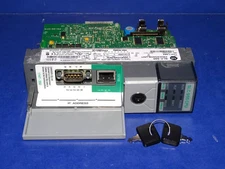
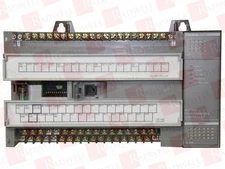
allen bradley slc 500 on eBay
See all →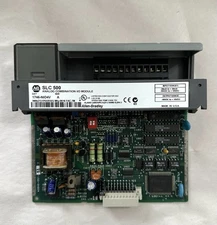
Firmware and Series Revision Compatibility
This is where I see the most expensive mistakes on eBay. Firmware compatibility on Allen Bradley Logix controllers is not optional -- it is a hard gate. If you buy a processor that does not support the firmware version your project requires, you have a paperweight.
Here is the core rule: the major firmware revision on the controller must match the major version of your programming software. If your project was built in Studio 5000 version 32, you need a processor that supports firmware revision 32.xxx. If you are running RSLogix 5000 version 20, you can only use controllers that support firmware 20.xxx. New Allen Bradley controllers ship from the factory with firmware revision 1.xxx. You must flash them to the version you need using ControlFLASH or Studio 5000's firmware update tool. This is standard practice and not a problem in itself -- the problem is when a processor's hardware cannot support the firmware version you need.
Series revisions drive firmware support boundaries. A 1756-L72 /A (Series A) supports a different range of firmware revisions than a 1756-L72 /B (Series B). Typically, Series B supports newer firmware versions and may drop support for older revisions that Series A handled. If your existing system runs firmware version 20 and you buy a Series B processor that only supports version 24 and later, you have a compatibility problem. You would either need to upgrade your entire project to a newer Studio 5000 version, or return the processor and find a Series A unit.
Rockwell's Product Compatibility and Download Center (PCDC) is the definitive source for which firmware versions each catalog number and series supports. Before you buy any processor on eBay, look up the exact catalog number, series letter, and confirm that your Studio 5000 version is compatible. This takes five minutes and prevents a $1,500 mistake.
The programming software split also matters for legacy platforms. SLC 500 and MicroLogix use RSLogix 500. PLC-5 uses RSLogix 5. CompactLogix and ControlLogix use RSLogix 5000 (older) or Studio 5000 Logix Designer (current). You cannot program a ControlLogix with RSLogix 500. This sounds obvious, but I have seen buyers on tight budgets purchase a CompactLogix processor not realizing that a Studio 5000 license costs several thousand dollars on top of the hardware purchase. RSLogix 500 for MicroLogix-only use is around $200 -- a fraction of the Studio 5000 cost.
One more firmware trap: downloading firmware from Rockwell requires an active TechConnect support contract. If you do not have one, you cannot download the firmware files needed to flash a new-in-box processor. Factor this cost in before buying sealed surplus that ships with firmware revision 1.
What Used and Surplus PLCs Actually Cost on eBay
Pricing varies by condition, seller reputation, and how urgently the market needs a particular catalog number. Here is what I see as of early 2026, based on real eBay sold listings and current market data.
CompactLogix 5370 (1769 series): The 1769-L30ER (1 MB memory) averages around $1,320 surplus. The 1769-L33ER (2 MB) averages $1,785. The 1769-L33ERM motion variant runs about $1,826. Used and pre-owned units from reputable US surplus dealers fall in the $800 to $1,200 range for the L30ER and $1,100 to $1,500 for the L33ER. These represent roughly 40-60% savings over authorized distributor list prices.
CompactLogix 5380 (5069 series): The 5069-L320ER (2 MB) averages $2,398 surplus. Sealed units from verified US sellers range from $1,730 to $2,710. The 5069-L330ER (3 MB) runs about $2,900 sealed. These are the current-generation controllers, so the discount versus distributor pricing is smaller -- typically 30-45%.
ControlLogix 5570 (1756-L7x series): The 1756-L72 (4 MB) averages $2,203 surplus with a range of $1,000 to $2,500 depending on condition and series. The 1756-L73 (8 MB) averages $1,875. The 1756-L75 (32 MB) averages $2,308. These are among the most traded AB processors on eBay, with over 2,000 active listings for each model.
ControlLogix 5580 (1756-L8xE series): The 1756-L82E (5 MB) averages $3,452 surplus, ranging from $2,400 to $5,500. This generation commands a premium because it is the current platform and genuinely new surplus units are harder to source in volume.
Legacy platforms: SLC 500 processors average around $420. MicroLogix averages about $492. PLC-5 pricing is all over the map depending on the specific processor and condition.
A general rule: if a listing shows a price 50% or more below the averages above and claims to be new, sealed, and shipping from the US, investigate the seller carefully. That pricing gap is the single biggest red flag for counterfeit or misrepresented goods. See our counterfeit detection guide for detailed inspection procedures.
Seven Questions to Ask Before Buying a PLC on eBay
Before I place a bid or hit "Buy It Now" on any AB processor listing, I get answers to these questions. Most reputable surplus dealers include this information in their listings. If they do not, message the seller. Silence or vague answers are a reason to walk away.
First: what is the exact catalog number and series letter? A listing that says "Allen Bradley CompactLogix" without specifying 1769-L33ER /A versus /B is not giving you enough information. The series letter determines firmware compatibility, and buying the wrong series can render the unit useless for your application.
Second: what firmware revision is currently loaded? Controllers pulled from running systems will have whatever firmware the previous owner installed. Sealed surplus units ship with firmware 1.xxx. Both are fine, but you need to know what you are getting so you can plan your flash procedure. If the seller says "firmware unknown," the unit has not been tested.
Third: has the processor been factory reset or does it still contain a program? A used CompactLogix or ControlLogix pulled from a decommissioned line may still hold the previous owner's ladder logic. That program might be source-protected (password locked). If it is, you may not be able to clear the memory without the password. Ask specifically: "Has the processor memory been cleared?"
Fourth: what is the key switch position, and does a key come with it? ControlLogix processors have a physical key switch with three positions: RUN, REM (Remote), and PROG (Program). The key is removable, and many used units ship without one. Replacement keys are available, but it is one more thing to deal with. CompactLogix 5370 units use a virtual key switch controlled through software, so this is less of a concern for that platform.
Fifth: is the SD card included? CompactLogix 5370 and ControlLogix 5570/5580 processors ship with a 1784-SD1 (1 GB) SD card. This card stores the program backup and is essential for nonvolatile storage. Used processors frequently arrive without the SD card. A replacement 1784-SD1 runs about $50 to $100 on its own.
Sixth: what is the manufacturing date code? Rockwell stamps a date code on every unit. Newer date codes generally mean newer hardware that supports later firmware revisions. A 2015-manufactured 1756-L72 may be Series A, while a 2020-manufactured unit is almost certainly Series B. Date codes also matter for warranty claims if you are buying sealed surplus -- Rockwell's standard warranty is one year from date of installation or 18 months from date of manufacture, whichever comes first.
Seventh: where does the seller actually ship from? This is the most important question in the current AB surplus market, and it deserves its own section below.
allen bradley plc processor on eBay
See all →

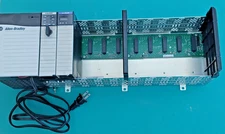
The Seller Location Problem -- and How to Solve It
Counterfeit and misrepresented Allen Bradley products on eBay are a documented, widespread problem. The most common pattern involves sellers who register with a US address but actually ship from China. They list "Item Location: United States" on eBay, which passes through eBay's location filters. When you receive the package two weeks later, the tracking shows it originated in Shenzhen or Hong Kong. The product inside may be counterfeit, a used unit repackaged as new, or a genuine unit with the serial number removed or altered.
eBay's built-in location filter uses the item location the seller declares, which means it can be faked. Several established US surplus dealers now include "REAL USA SELLER - NOT CHINA" in their listing titles -- a telling sign of how pervasive this problem has become.
uBuyFirst addresses this directly by showing you the seller's registered country, not just the item location. Every listing on uBuyFirst displays a country flag next to the seller name. That flag comes from the seller's eBay registration data, which is much harder to fake than an item location field. When I am scanning Allen Bradley PLC processor listings, I filter immediately by seller country. If the flag does not show a US registration and the listing claims domestic stock, I skip it.
Beyond seller country, watch for these signals: stock photos instead of actual product photos, listings with no visible serial number or data plate, prices significantly below market averages, new eBay accounts with limited feedback history, and sellers with massive inventories of sealed AB products across every catalog number. Established US surplus dealers like those with 10,000+ feedback and years of history are where I focus my buying. For a full breakdown of inspection techniques, read our counterfeit detection guide.
Testing a Used PLC When It Arrives
Every used or surplus processor gets bench-tested before I put it in a panel. Here is my standard verification procedure.
Start with a visual inspection. Check the housing for cracks, burn marks, or evidence of liquid exposure. Look at the backplane connector pins -- bent or corroded pins indicate a module that was forced into a slot. Inspect the label for the correct catalog number, series letter, and date code. Compare the serial number to what the seller listed. If the serial number does not match or appears altered, do not install it.
Power it up on a bench. For CompactLogix 5370, you need a 1769-series power supply (1769-PA2 or 1769-PB4) and an end cap (1769-ECR). For ControlLogix, you need a 1756 chassis, a 1756-PA72 or similar power supply, and the processor itself. Apply power and watch the front-panel LEDs. A healthy processor should cycle through its boot sequence and settle into a solid pattern. Consult the user manual for your specific catalog number to understand what each LED state means. A solid red FAULT LED is not necessarily bad on first power-up -- it often just means no program is loaded.
Connect via USB or Ethernet. Plug a USB-B cable into the processor's USB port and open RSLinx Classic on your laptop. RSLinx should discover the controller automatically through the USB driver. Once connected, you can see the firmware revision, processor status, and fault log. The fault log is valuable -- it tells you the history of faults the processor has experienced, including recoverable and major faults. A fault log full of I/O communication errors suggests the processor was pulled from a system with wiring problems, not necessarily a processor defect.
Check the memory. In RSLinx or Studio 5000, verify that the user memory size matches the catalog number specification. A 1769-L33ER should show 2 MB of available user memory. If the memory size does not match, the processor may have been modified or is not the catalog number it claims to be.
Load a test program. Create a simple project in Studio 5000 matching the processor's catalog number and firmware revision. Add a few rungs of basic logic -- a timer, a counter, a math instruction. Download it to the processor and put it in Run mode. Let it run for 30 minutes to an hour. If the processor faults, drops out of Run, or behaves erratically, you have a hardware problem.
Check the battery. ControlLogix processors use a 1756-BA2 lithium battery to maintain program memory during power loss. CompactLogix 5370 uses a 1769-BA battery. Check the battery status LED. If the battery is dead or low, replace it before deploying the processor. Batteries are inexpensive ($15 to $30) but critical -- a dead battery means your program is lost on the next power cycle if the SD card is not configured for automatic backup.
allen bradley compactlogix on eBay
See all →
Common Gotchas That Cost You Time and Money
After buying hundreds of AB processors through eBay and surplus channels, I have compiled the mistakes I see most often -- both my own and from other integrators I work with.
Locked processors. Source protection on Logix controllers allows the original programmer to password-protect the program. If you buy a used processor with a locked program, you cannot upload, modify, or even view the logic without the password. Clearing a locked program requires a full memory clear, which erases everything. That is fine if you plan to load your own program, but if you were counting on uploading the existing logic to understand the machine, you are out of luck. Always ask if the processor has been wiped before buying used.
Wrong series for your project. This is the firmware trap I described earlier, but it bears repeating because it is the single most common technical mistake. You buy a 1756-L73 /B Series B because it was $200 cheaper than the Series A unit, and then discover your v20 project cannot communicate with it because Series B only supports v24 and later. Always check the PCDC before buying.
Obsolete firmware with no upgrade path. Some older CompactLogix controllers (1769-L31, L32E, L35E) only support firmware up to revision 20. If your plant has standardized on Studio 5000 v30 or later, these controllers simply will not work. They are not upgradeable. The only option is a different controller that supports the firmware version you need. Check maximum supported firmware before buying any older catalog number.
Missing keys and SD cards. As mentioned in the questions section, ControlLogix keys and SD cards are frequently missing from used units. Neither is expensive to replace, but if you need the processor running today and do not have a spare key or SD card on the shelf, you are waiting on a shipment. Keep a few 1784-SD1 cards and 1747-KY replacement keys in your parts inventory.
Buying I/O modules that do not match your processor platform. If you are assembling a complete CompactLogix system, you need 1769-series I/O for a 5370 controller and 5069-series I/O for a 5380 controller. These are not interchangeable. I have seen buyers purchase a 5069-L320ER processor and then order 1769 I/O modules, only to discover they need an entirely different I/O lineup. Read our I/O modules guide for details on matching I/O to your processor platform.
Condition grading confusion. "Surplus" typically means the unit was purchased from an authorized distributor but never installed -- factory packaging, current date codes, essentially new. "Refurbished" means the unit was pulled from service, tested, cleaned, and sold with a dealer warranty. "Used" means pulled from service with no dealer warranty beyond eBay's buyer protection. "New Open Box" is a gray area -- it could mean anything from a surplus unit with opened packaging to a returned item. For a deeper dive on condition grades and what they mean for your risk profile, see our surplus vs. refurbished guide.
Finally, never assume a sealed box is genuine just because it looks sealed. Counterfeiters have gotten good at replicating Rockwell packaging, labels, and even shrink wrap. Sealed units from sellers with no US footprint and prices well below market should be treated as suspect until verified. The combination of seller country verification through uBuyFirst and physical inspection upon receipt is your best defense.