How to Buy Gold on eBay: Coins, Bars, and Bullion Buyer's Guide
uBuyFirst
I bought my first ounce of gold on eBay in 2019 — a 1 oz American Gold Eagle from APMEX's eBay store, paid with a credit card that earned 2% cash back, and had it in my hands three days later. That single transaction taught me something the precious metals industry doesn't advertise: eBay is one of the largest gold marketplaces on earth, with over 53,000 gold bullion listings live at any given moment, and if you know what you're doing, it can be the smartest place to buy. The problem is that for every legitimate listing from a dealer with 295,000 positive feedback ratings, there's a tungsten-filled fake shipping from a warehouse in Shenzhen with a claimed location of "Dallas, Texas." Gold with a spot price above $5,100 per ounce means a single bad purchase can cost you thousands. This guide covers everything I've learned buying gold on eBay across coins, bars, and rounds — from understanding premiums over spot price to vetting sellers, detecting counterfeits, and using eBay's buyer protections to your advantage.
Gold Coins, Bars, and Rounds on eBay: Choosing Your Format
The gold you'll find on eBay falls into three broad categories, and each serves a different purpose in a buyer's strategy. Understanding the differences before you search saves time and prevents costly mistakes.
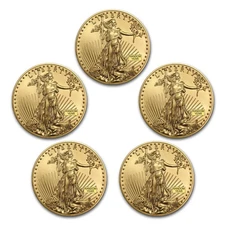
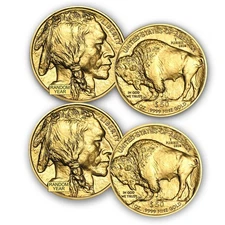
Gold coins are government-minted legal tender with a face value (however nominal) and carry the highest premiums but also the greatest liquidity and recognition. The American Gold Eagle is the most traded gold coin on eBay, with the 1 oz BU version selling around $5,350-$5,550 in early 2026. Eagles are 22-karat (91.67% gold, alloyed with copper and silver for durability), which gives them a distinctive warm color and scratch resistance. The Canadian Gold Maple Leaf is .9999 fine (24-karat pure gold), making it the purest mainstream bullion coin but also softer and more prone to handling marks. South African Krugerrands are the original modern bullion coin — over 60 million minted since 1967 — and typically trade at the lowest premiums of the three because of that massive supply. Other popular coins include the British Britannia, Austrian Philharmonic, and the American Gold Buffalo (.9999 fine, the US Mint's answer to the Maple Leaf). For a deep dive into specific coin types, premiums by series, and numismatic vs. bullion considerations, see the gold coins buying guide.
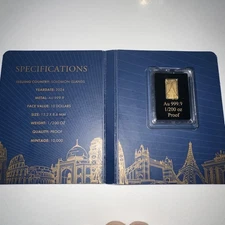
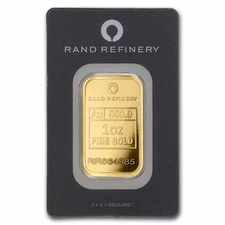
Gold bars are produced by private refiners and carry lower premiums than coins because they have no face value, no legal tender status, and lower production costs. A 1 oz gold bar from a LBMA-accredited refiner like PAMP Suisse, Valcambi, or Perth Mint typically sells at 1-3% over spot, compared to 3-5% for coins. The tradeoff is that bars are slightly less liquid — a coin shop will buy back an American Eagle instantly at a known price, while an unbranded bar may require assay testing. Bars come sealed in assay cards from the refiner, which serves as both packaging and a certificate of authenticity. The 1 oz gold bar is the most popular size on eBay, but you'll also find fractional bars (1g, 5g, 10g, 20g) and larger 10 oz bars for serious buyers. For refiner-specific guidance and assay card verification, see the gold bars buying guide.
Gold rounds look like coins but are produced by private mints with no face value or legal tender status. They're essentially a hybrid — coin-shaped for stackability and appeal, bar-priced for lower premiums. Browse gold rounds on eBay and you'll find products from Scottsdale Mint, Sunshine Minting, and dozens of smaller producers. Rounds are a solid choice when you want maximum gold for minimum premium, but they carry slightly higher counterfeit risk than government coins because there's no single "official" design to authenticate against.
Beyond bullion, eBay is also a marketplace for gold jewelry lots and scrap gold — broken chains, mismatched earrings, dental gold — purchased for melt value. The math is different here: you're calculating karat purity, weighing in grams, and comparing to spot price minus refining costs. It can be profitable, but the margin for error is thin and the counterfeit risk is higher than with standardized bullion products. The scrap gold and melt value guide covers karat testing, hallmark identification, and how to calculate whether a lot is worth bidding on.
Understanding Gold Premiums and Spot Price on eBay
Every gold purchase on eBay is a negotiation between two numbers: the spot price and the premium. Spot price is what one troy ounce of pure gold trades for on the commodities market right now. As of early March 2026, gold spot sits above $5,100 per ounce. The premium is everything above spot — minting costs, dealer margin, eBay fees, and supply-demand dynamics for that specific product.
Here's the premium hierarchy I've observed on eBay in 2026, ranked from lowest to highest for 1 oz products: generic gold bars and rounds (1-3% over spot), name-brand bars from PAMP or Perth Mint (2-4%), Krugerrands and Maple Leafs (2-4%), American Gold Eagles (3-5%), PCGS-graded coins (5-15%+ depending on grade), and pre-1933 US gold coins (highly variable, driven by numismatic value rather than metal content). A 2026 Gold Eagle BU from APMEX on eBay lists around $5,380 — that's roughly a 4% premium when spot is $5,163. The same coin from APMEX's own website might be $5,295 if you pay by bank wire, but $5,453 with a credit card because APMEX charges a 3% CC surcharge on their site. On eBay, credit card payments carry no surcharge because eBay absorbs the processing cost as part of its seller fees. That CC arbitrage alone can close the premium gap between eBay and direct-dealer pricing.
Use sold listings as your pricing compass. Before committing to any gold purchase on eBay, search for the exact product and filter by "Sold Items" (the green prices). This tells you what buyers actually paid, not what sellers are hoping to get. I've seen asking prices 10-15% above what identical items actually sell for. The sold-listings data gives you a negotiation baseline for any Best Offer listing. Many gold listings on eBay include the "or Best Offer" option — on listings that have been active for 30+ days, offering 5-10% below asking price is reasonable and frequently accepted.
Fractional gold carries higher percentage premiums. A 1/10 oz Gold Eagle at $576 represents a premium of roughly 12% over spot on a per-ounce basis. That's not a rip-off — it's the cost of divisibility. Minting, packaging, and shipping a 1/10 oz coin costs nearly as much as a 1 oz coin, so the fixed costs spread over less metal. If you're buying fractional gold on eBay, expect this premium and factor it into your strategy. The gold premiums guide breaks down premium math by product type, size, and timing.
The credit card advantage is real. Most online gold dealers charge 3-4% extra for credit card payments and offer discounts for bank wire or check. On eBay, credit card processing is built into the platform — no surcharge to the buyer. If your credit card earns 1.5-2% cash back, you're effectively reducing your premium by that amount. A 1 oz Gold Eagle at $5,380 on eBay with 2% cash back nets out to $5,272 effective cost. That's competitive with bank-wire pricing from direct dealers, plus you get credit card purchase protection as a bonus layer of security.
How to Vet Gold Sellers on eBay
Seller selection is the single most important decision you'll make when buying gold on eBay. Get this right and the counterfeit risk drops to near zero. Get it wrong and you're fighting for a refund on a tungsten-filled bar.
Start with the established eBay bullion dealers. These are companies that operate both their own e-commerce sites and eBay storefronts, with hundreds of thousands of transactions and near-perfect feedback. APMEX runs one of the largest eBay stores in any category — over 617,000 items sold with 99.8% positive feedback. Aydin Coins has 295,600 feedback at 99.8% positive. JM Bullion, Scottsdale Mint, BGASC (Buy Gold And Silver Coins), Liberty Coin, and Bullion Exchanges all maintain active eBay storefronts with deep inventory and established track records. When you buy from these sellers, you're getting the same product and the same authentication standards as their direct websites, often at competitive prices because eBay's competitive marketplace keeps pricing honest. For a complete seller directory and evaluation framework, see the trusted dealers and authentication guide.
Feedback depth matters more than percentage. A seller with 50,000 feedback at 99.9% positive has survived a decade of buyer scrutiny in one of eBay's highest-risk categories. A seller with 47 feedback at 100% positive is statistically meaningless — they could be a new account set up last month specifically to sell counterfeits before disappearing. Click into the feedback and read the actual comments. Look for phrases like "genuine," "exactly as described," "fast shipping" from buyers who clearly purchased gold or silver. Look for repeat buyers — professional stackers who find a good eBay dealer come back to them month after month.
Check the seller's location — their real location. This is where uBuyFirst changes the game. eBay lets sellers self-declare their "Item Location," and Chinese counterfeit operations routinely claim US cities. A seller physically based in Guangzhou can list their item location as "Miami, FL." eBay's policy requires accurate location reporting, but enforcement is reactive. uBuyFirst displays the seller's actual registered country, not the self-declared item location. When you're browsing gold bullion listings through uBuyFirst, you can immediately filter by seller country and see whether a seller is registered in the US or in China, regardless of what the listing claims. For gold purchases where a single counterfeit can cost $5,000+, that visibility is the most valuable filter available.
Avoid these seller red flags: new accounts (under 6 months) selling high-value gold; prices more than 10% below what established dealers charge for the same product; stock photos instead of original photographs of the actual item; vague descriptions like "gold bar 1 oz" with no refiner, assay card, or serial number mentioned; and item locations that don't match the seller's registered country. If a 1 oz gold bar is listed at $3,200 when spot is $5,100, that's not a deal — it's a trap.
buy gold on ebay on eBay
See all →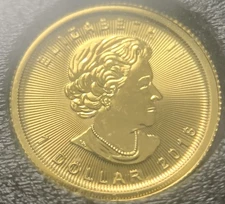
The Counterfeit Threat: Fake Gold on eBay
I'm going to be direct about this because the risk is real and the consequences are expensive: counterfeit gold on eBay is a persistent, well-organized problem, and if you buy gold regularly without precautions, you will eventually encounter a fake. One eBay community member reported that out of their last 13 gold purchases, only 2 were authentic — an extreme case, but it illustrates what happens when buyers prioritize price over seller vetting.
Tungsten-filled bars are the most sophisticated counterfeit. Tungsten has a density of 19.25 g/cm3, compared to gold's 19.32 g/cm3 — a difference of less than 0.4%. This means a tungsten core wrapped in real gold will weigh correctly, measure correctly on calipers, and pass a basic acid test. The bar arrives in convincing packaging with serial numbers, assay cards, and refiner logos that look genuine to anyone who hasn't seen the real thing side by side. Counterfeit PAMP Suisse bars are among the most commonly reported fakes on eBay, because PAMP's high premium makes them an attractive target and the genuine packaging is widely photographed for counterfeiters to replicate.
Fake coins follow predictable patterns. The most counterfeited gold coins are American Eagles, Krugerrands, and Maple Leafs — the highest-volume coins with the broadest buyer pool. Counterfeits typically originate from Chinese factories and get listed on eBay through accounts that claim US locations. The telltale signs include slightly wrong dimensions (counterfeit dies produce coins that are often 0.1-0.5mm off in diameter or thickness), mushy design details compared to genuine strikes, incorrect edge reeding, and weight that's off by more than 0.1 grams. For a comprehensive breakdown of detection techniques by coin type, see the counterfeit detection guide.
The "too good to be true" rule is absolute for gold. Gold is one of the most efficiently priced commodities on earth. Every dealer, every marketplace, every private seller knows the spot price within seconds. If a listing is priced more than 5-8% below what established dealers charge for the same product, something is wrong. The gold isn't what it claims to be, the seller doesn't intend to ship it, or the listing is a bait-and-switch. I've seen fake 1 oz gold bars listed at $94-95 — over 98% below actual value. Those listings prey on buyers who don't know what gold costs.
Counterfeit NGC and PCGS slabs exist. Third-party grading used to be the gold standard for authentication, and it still is — but counterfeiters have started producing fake plastic slabs with fake certification numbers. Always verify the certification number on the NGC (ngccoin.com/certlookup) or PCGS (pcgs.com/cert) website before finalizing any purchase. A genuine slab has specific security features: NGC uses edge-to-edge holographic labels, and PCGS uses their proprietary anti-counterfeiting technology with unique serial numbers. If the cert number doesn't match the coin described, or if the slab looks subtly different from the photos on the grading company's website, walk away.
Authentication and Grading: NGC, PCGS, and Third-Party Verification
For anyone who isn't confident in their ability to authenticate raw gold, buying NGC-graded or PCGS-graded coins is the most reliable path to authenticity on eBay. These two organizations are the undisputed leaders in coin authentication and grading — every major dealer accepts their grades, and their encapsulated "slabs" provide tamper-evident protection with a verifiable certification number.
How grading works: When a coin is submitted to NGC or PCGS, a panel of expert numismatists examines it for authenticity, then assigns a grade on the 70-point Sheldon Scale. For bullion buyers, the grades that matter are MS-69 (near-perfect, typical for modern bullion coins) and MS-70 (perfect, carrying a significant premium). A 2026 Gold Eagle graded PCGS MS-70 will sell for $5,500-$5,700 on eBay, compared to $5,350-$5,400 for an ungraded BU coin. That $150-$300 premium buys you a guarantee of authenticity, a verified grade, and tamper-evident encapsulation that makes resale easier.
For bullion buyers, MS-69 is the sweet spot. MS-70 coins carry a collector premium that fluctuates with demand, while MS-69 coins trade much closer to bullion value with the authentication benefit intact. If your goal is gold accumulation rather than numismatic collecting, MS-69 gives you verified authenticity at minimal additional cost.
eBay's Authenticity Guarantee program currently covers watches, sneakers, handbags, jewelry (over $500, authenticated by GIA), and trading cards. As of early 2026, gold bullion coins and bars are not enrolled in the Authenticity Guarantee program, though eBay's Q4 2025 earnings call mentioned investment in broadening the program to more categories, and community members have been vocal about wanting AG extended to the coin and bullion markets. Until that happens, third-party grading from NGC or PCGS remains the strongest authentication layer available for eBay gold purchases.
Perth Mint security features are worth knowing about. Perth Mint bullion coins include a micro-laser engraved authentication letter that's only visible under magnification — a feature counterfeiters have not yet replicated successfully. Perth Mint minted bars are sealed in tamper-evident packaging that displays "VOID" around the edges if the blister card has been opened. If you're buying Perth Mint gold on eBay, check for these features.
gold coins ebay on eBay
See all →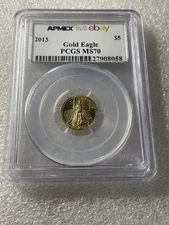


Testing Gold: From Kitchen Table to Professional Tools
Even when you buy from reputable sellers, having the ability to verify what you receive builds confidence and catches the rare mistake. Here's the testing hierarchy, from simplest to most definitive.
Weight and dimensions are your first check. Every bullion product has published specifications. A 1 oz American Gold Eagle should weigh 33.931 grams (one troy ounce of gold plus the copper/silver alloy), measure 32.7mm in diameter, and be 2.87mm thick. A 1 oz Maple Leaf is 31.1 grams (pure gold, no alloy), 30mm diameter, 2.87mm thick. A precision scale accurate to 0.1g costs $15-30, and a digital caliper costs $10-20. If the weight or dimensions are off by more than the published tolerances, stop and investigate.
The magnet test eliminates crude fakes. Gold is diamagnetic — a strong neodymium magnet should produce essentially no attraction. If a magnet sticks to your bar or coin, it's ferrous metal, not gold. The limitation is that tungsten is also non-magnetic, so a tungsten-filled fake passes this test. The magnet test catches the cheap copper or steel fakes, not the sophisticated ones.
The ping test works for coins. Strike a genuine gold coin on a hard surface and it produces a distinctive, sustained, high-pitched ring. Counterfeit coins made from base metals produce a dull thud or a short, flat tone. Smartphone apps like CoinTester and Bullion Test analyze the sound frequency against known values for specific coins — a 1 oz Gold Eagle rings at a different frequency than a Maple Leaf because the alloy composition differs. The ping test is surprisingly effective and completely free.
Sigma Metalytics Precious Metal Verifier is the professional-grade tool used by coin shops and dealers. It measures the electrical resistivity of the metal and compares it to known values — gold, silver, platinum, and palladium each have unique resistivity signatures. The PMV can read through packaging, coin flips, and even numismatic slabs. At $700-$1,500 for the unit plus wands, it's a serious investment, but if you're regularly buying gold worth $50,000+, the one-time cost is negligible insurance. The important limitation: the Sigma tester cannot detect all fakes, particularly sophisticated tungsten-core pieces where the gold skin is thick enough to dominate the reading.
XRF (X-Ray Fluorescence) testing is available at most coin dealers and pawn shops for $10-50 per test. XRF identifies the elemental composition of the surface — it will confirm that the outer layer is gold and tell you the purity. However, XRF only penetrates 10-50 microns deep, meaning it cannot detect a tungsten core beneath a thick gold layer. For bars and coins that pass XRF but you still have doubts, ultrasonic thickness testing can detect internal density inconsistencies. Combining XRF surface analysis with ultrasonic bulk testing is the most comprehensive non-destructive authentication available.
eBay Buyer Protections for Gold Purchases
eBay provides meaningful buyer protection for gold purchases, though the protections have specific mechanics you need to understand before they're useful in a dispute.
eBay Money Back Guarantee is your baseline protection on every gold transaction. If the item doesn't arrive, or arrives "not as described" — which includes counterfeit items — you're covered for the full purchase price plus original shipping. You have 30 days from delivery to open a case. The process: contact the seller first, give them three business days to respond, then escalate to eBay if they don't resolve it. For counterfeit gold, photograph everything before and after opening — the package, the item from all angles, weight on a scale, and any testing results. Specific documentation dramatically strengthens your claim.
Credit card chargeback rights add a second layer. If eBay's Money Back Guarantee process fails or the 30-day window closes before you discover a counterfeit, your credit card company provides an independent dispute mechanism. Most credit cards allow chargebacks for 60-120 days from the transaction date for items that are "not as described" or counterfeit. This is one of the strongest arguments for paying with a credit card rather than eBay gift cards or debit cards — you retain independent recourse beyond eBay's own process.
Document everything on arrival. When high-value gold arrives, photograph the package before opening it. Photograph the seal or tape. Photograph the item from every angle, including the assay card or certification slab. Weigh the item immediately and photograph the scale reading. If the item is a graded coin, look up the certification number on the grading company's website immediately and screenshot the result. If anything is wrong — weight off, dimensions off, cert number doesn't verify, design details look fuzzy — document it before contacting the seller. This evidence trail is what separates a successful claim from a he-said-she-said dispute.
eBay requires buyer verification for gold and bullion purchases. This is a relatively recent policy change designed to reduce fraud on both sides. Buyers must be verified by eBay before bidding on or purchasing gold bullion. Replica, copy, counterfeit, plated, or clad bullion is explicitly prohibited under eBay's bullion policy, including items described as "German silver" or "nickel silver." If you spot a listing that appears to be counterfeit gold, report it using the "Report item" link — though be aware that eBay's automated review doesn't catch everything, and community members have reported frustration with listings remaining active despite reports.
Why Seller-Country Filtering Changes Everything for Gold Buyers
I started using uBuyFirst after wasting an evening clicking through gold bar listings only to discover, buried in the fine print or visible only after examining seller profiles, that the "US-based" sellers were registered in China. That experience crystallized something I already knew but kept learning the hard way: for gold, where you're buying from matters as much as what you're buying.
The Chinese counterfeit pipeline is the gold market's biggest problem. The Perth Mint states it directly on their website: "Despite eBay's rules and policies forbidding the listing of replicas, counterfeit items or unauthorised copies, there are many products from large manufacturers and well-known brands that are imitated and offered for sale." eBay community forums are filled with reports of fake gold bars and coins, and the pattern is consistent — the counterfeits overwhelmingly trace back to Chinese manufacturing operations that sell through eBay accounts with claimed US locations.
uBuyFirst's seller-country filter cuts through this. Instead of trusting the self-declared item location (which eBay lets sellers set to anything), uBuyFirst shows the seller's registered country. You can filter search results to show only sellers registered in the United States, Canada, the UK, or other countries with strong consumer protection frameworks. For 1 oz gold coins, this single filter eliminates the vast majority of counterfeit risk before you even evaluate individual listings.
Real-time search alerts for specific products let you monitor eBay for deals from trusted sellers without refreshing searches all day. Set an alert for "1 oz gold eagle" or "PAMP 1 oz gold bar" on uBuyFirst and you'll get notified when new listings appear. In a market where desirable products at competitive premiums sell quickly, being early to a listing from a known dealer is often the difference between getting the price you want and missing it.
Market insights on browse pages — average price, price range, total listings, condition breakdown — give you the context to evaluate any individual listing against the broader market. When you can see that the average price across thousands of gold coin listings is $436 (including fractional sizes and lower-value items), and then you find a specific 1 oz Eagle at $5,380, you can assess whether that's competitive without manually checking twenty other listings.
gold bars ebay on eBay
See all →
Start Building Your Gold Position
Every strategy in this guide — seller vetting, premium analysis, counterfeit detection, testing, buyer protections — exists because the gold market on eBay rewards informed buyers and punishes careless ones. The gap between a great gold purchase and a devastating one isn't luck. It's preparation.
Start with the product type that fits your goals. If you want maximum recognition and liquidity, begin with American Gold Eagles. If you want the lowest premiums on recognizable government coins, look at Krugerrands or Maple Leafs. If you want maximum gold per dollar, explore 1 oz gold bars from LBMA-accredited refiners. If you want guaranteed authentication, browse PCGS-graded or NGC-graded gold coins. And if you're interested in buying gold below spot through karat jewelry lots, the melt value guide is your starting point.
Buy from established dealers first. Stick to sellers with tens of thousands of positive feedback in the bullion category. Use uBuyFirst to filter by seller country and set up alerts for the specific products you're targeting. Verify your first purchases with at least a weight and dimensions check, and consider investing in a Sigma Metalytics tester if you plan to accumulate significant holdings over time.
Browse by product type: gold bullion, gold coins, gold rounds, PAMP Suisse bars, Valcambi bars, Perth Mint products, Gold Sovereigns, proof gold coins, or pre-1933 US gold. Then go deeper with the rest of this guide cluster: gold coin types, gold bars and refiners, premiums and pricing, counterfeit detection, scrap gold and melt value, and trusted dealers and authentication.